
El desarrollo de pastas conductoras comenzó en la década de 1950. En 1954, el investigador británico C.F. Powell fue el primero en informar sobre el método de preparación de pastas conductoras mediante la suspensión de partículas de plata en disolventes orgánicos, sentando así las bases técnicas. Posteriormente, en las décadas de 1960 y 1970, con el auge de los circuitos integrados híbridos de película gruesa, las pastas conductoras de metales preciosos, como la pasta de plata y la pasta de oro, alcanzaron gradualmente su industrialización inicial y se utilizaron principalmente en las industrias aeroespacial y militar. Tomando como ejemplo las materias primas para la pasta de plata fotovoltaica, el polvo de plata representa más del 90 % del coste, y su precio de compra se ve muy afectado por las fluctuaciones del precio de la plata en el mercado. Desde 2020, impulsados por los altos precios de la plata y la demanda de reducción de costes, se ha introducido y aplicado la pasta de cobre recubierta de plata en las líneas de producción de baterías HJT. Se han logrado avances significativos en la pasta de cobre puro y la tecnología de cobre electrochapado, y se ha puesto en marcha la producción en masa. El contenido de plata se ha reducido considerablemente y el proceso sin plata se ha acelerado notablemente.
Actualmente, las tres principales líneas tecnológicas para sustituir la pasta de plata conductora son: la pasta de cobre recubierta de plata, el proceso de cobre electrochapado y la pasta de cobre/aluminio puro. Su objetivo es solucionar el problema del elevado precio de la plata y ya se encuentran en fase de industrialización en sectores como la energía fotovoltaica y el encapsulado de LED.
Las principales diferencias entre estas tres rutas tecnológicas son las siguientes:
1. Tecnología de plata en cobre: La tecnología de plata en cobre es actualmente la solución de reemplazo de cobre más madura y de más rápido crecimiento en el mercado. Su base es la estructura de núcleo-capa de cobre y plata, que reemplaza parcialmente la plata con cobre. Al ajustar la proporción de dopaje de plata y cobre, se puede reducir eficazmente el costo de la pasta, manteniendo la eficiencia de conversión fotoeléctrica, y la reducción de costos puede alcanzar más del 30 %. Sin embargo, debido a la fácil oxidación del polvo de cobre en entornos de alta temperatura, la aplicación de este método presenta limitaciones evidentes y solo es adecuado para sistemas de pasta de plata de baja temperatura en células fotovoltaicas de heterounión de silicio cristalino (HJT) y células fotovoltaicas apiladas.
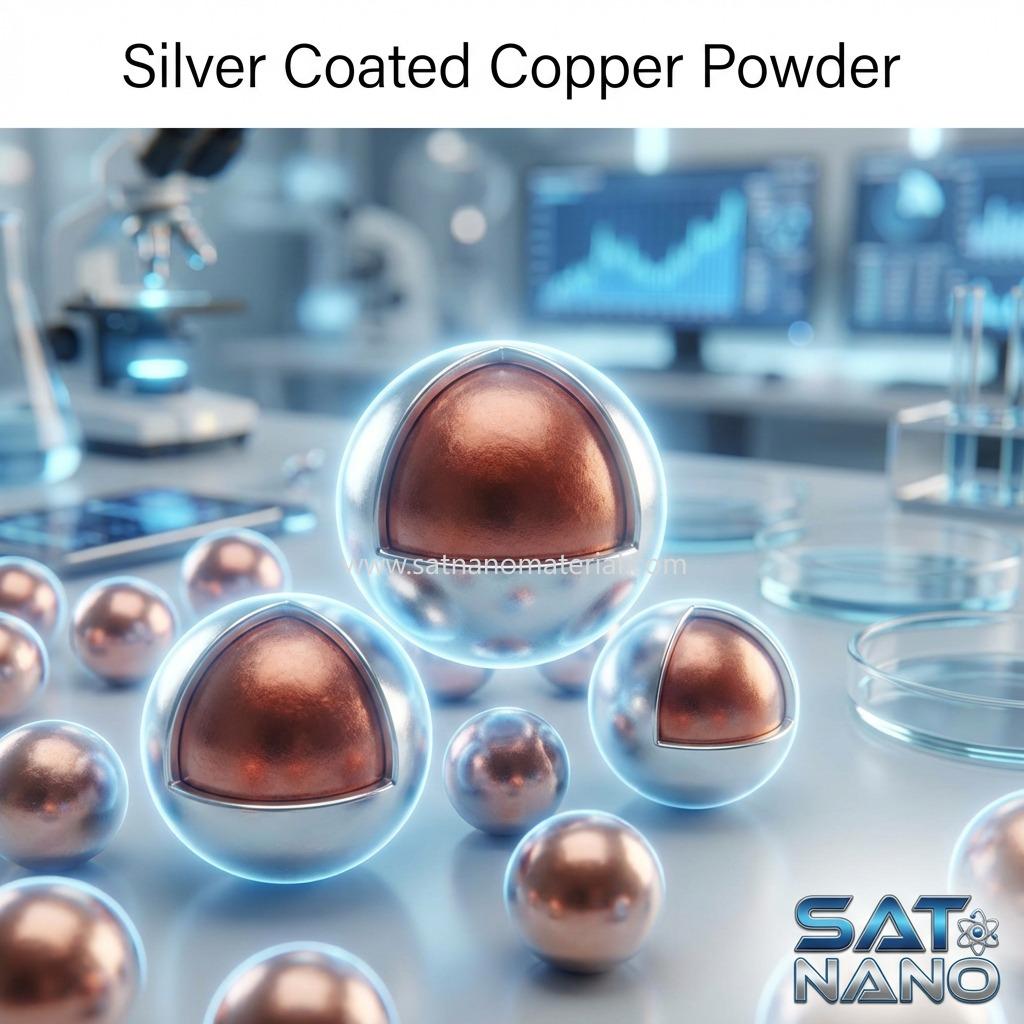
La aparición del polvo de cobre recubierto de plata tiene como objetivo principal reducir significativamente los costos manteniendo una conductividad cercana a la de la plata pura. La técnica de SAT NANO, Dana, obtuvo los siguientes datos comparativos a partir de experimentos con polvo de plata conductor y polvo de cobre recubierto de plata conductor.
Aquí se presenta una comparación de los parámetros clave de rendimiento entre ambos:
|
Parámetro técnico
|
Polvo de plata conductor (Ag pura)
|
Polvo de cobre conductor recubierto de plata (Cu recubierto de Ag)
|
Resumen comparativo
|
|
Resistividad volumétrica
|
10−5∼10−4 Ω⋅cm
|
10−4∼10−3 Ω⋅cm
|
La plata es ligeramente superior, pero el cobre recubierto de plata cumple con la mayoría de los requisitos industriales.
|
|
Estabilidad / Fiabilidad
|
Excelente; altamente resistente a la oxidación.
|
Alta; depende de la densidad y la integridad del recubrimiento de plata.
|
La plata pura ofrece una estabilidad eléctrica superior a largo plazo.
|
|
Densidad
|
Aprox. 10,5 g/cm³
|
Aprox. 8,9∼9,1 g/cm38,9∼9,1 g/cm3
|
El cobre recubierto de plata es más ligero, lo que proporciona un mayor volumen de llenado por unidad de masa.
|
|
Contenido de plata (Ag %)
|
99,9%∼100%
|
3%∼30% (comúnmente 10%∼20%)
|
El cobre recubierto de plata reduce significativamente el consumo de metales preciosos.
|
|
Costo / Precio
|
Alto (Muy sensible a las fluctuaciones del mercado de la plata).
|
Aprox. 1/3∼1/5 de polvo de plata pura.
|
El cobre recubierto de plata presenta una clara ventaja en cuanto a costes.
|
2. La tecnología de electrodeposición de cobre se basa en el principio de deposición electrolítica, que puede utilizar la capa conductora transparente y la estructura de guía de borde preestablecidas en ambos lados de la celda fotovoltaica para preparar sincrónicamente electrodos metálicos en la parte frontal y posterior de la celda, sin necesidad de sinterización a alta temperatura ni procesamiento paso a paso de una sola cara. Tiene compatibilidad metálica natural de doble cara y puede aprovechar plenamente las ventajas de rendimiento de la generación de energía de doble cara de la batería HJT; al mismo tiempo, los electrodos recubiertos de cobre tienen una conductividad y características de contacto significativamente mejores con capas de óxido conductor transparente (TCO) que las líneas de rejilla de plata tradicionales. Están hechos de material de cobre puro y tienen una estructura densa sin huecos, con una resistividad eléctrica mucho menor que la pasta de plata de baja temperatura. Esto puede reducir eficazmente las pérdidas óhmicas del electrodo y la resistencia en serie, y se combinan firmemente con películas conductoras transparentes de TCO sin orificios de contacto, lo que puede reducir la resistencia de contacto, mejorar la adhesión del electrodo y la eficiencia de recolección de transporte de portadores; Además, los electrodos recubiertos de cobre pueden alcanzar anchos de línea ultrafinos de 15-20 μm, con mejores relaciones de aspecto y buena plasticidad. En comparación con las líneas de rejilla de plata impresas con 30-40 μm, pueden reducir significativamente las pérdidas por sombreado. Combinados con características de baja resistividad, pueden mejorar eficazmente la eficiencia de generación y recolección de portadores fotogenerados, y aumentar la eficiencia de conversión de las células fotovoltaicas de heterounión entre un 0,3% y un 0,5%. Actualmente, el proceso de electrodeposición de cobre aún enfrenta ciertas dificultades en la producción en masa. En comparación con la serigrafía tradicional, el proceso de electrodeposición de cobre es más largo y propenso a situaciones como el desprendimiento de la rejilla y la oxidación. Además, debido al flujo de proceso complejo, el costo de inversión inicial en equipos es relativamente alto. Por otro lado, la solución de electrodeposición contiene una gran cantidad de productos químicos nocivos, lo que plantea riesgos de cumplimiento ambiental y, en cierta medida, restringe su promoción a gran escala. Actualmente, la industrialización de la tecnología de electrodeposición de cobre aún requiere tiempo.
3. La pasta de cobre puro es la solución ideal para reducir costos sin plata a mediano y largo plazo, ya que puede reemplazar completamente la pasta de plata y tiene el mayor potencial de reducción de costos. Sin embargo, su aplicación a gran escala aún enfrenta desafíos técnicos fundamentales. Debido a las propiedades químicas activas y la alta energía superficial específica del polvo de cobre, este tiende a entrar en contacto con el aire durante la preparación y la producción de baterías, formando películas de óxido aislantes que reducen la conductividad de la suspensión. Por lo tanto, el avance tecnológico en el tratamiento antioxidante del polvo de cobre se ha convertido en la clave para la aplicación industrial de la suspensión de cobre. Actualmente, los productos de pasta de cobre puro para procesos de baja y alta temperatura aún se encuentran en la etapa de investigación y desarrollo.
SAT NANO es un proveedor de los mejores polvo de plata , polvo de cobre recubierto de plata En China, podemos suministrar partículas de diferentes tamaños. Si tiene alguna consulta, no dude en contactarnos a través de admin@satnano.com.


 Servicio en línea
 13929258449
 admin@satnano.com
 + 8613929258449


