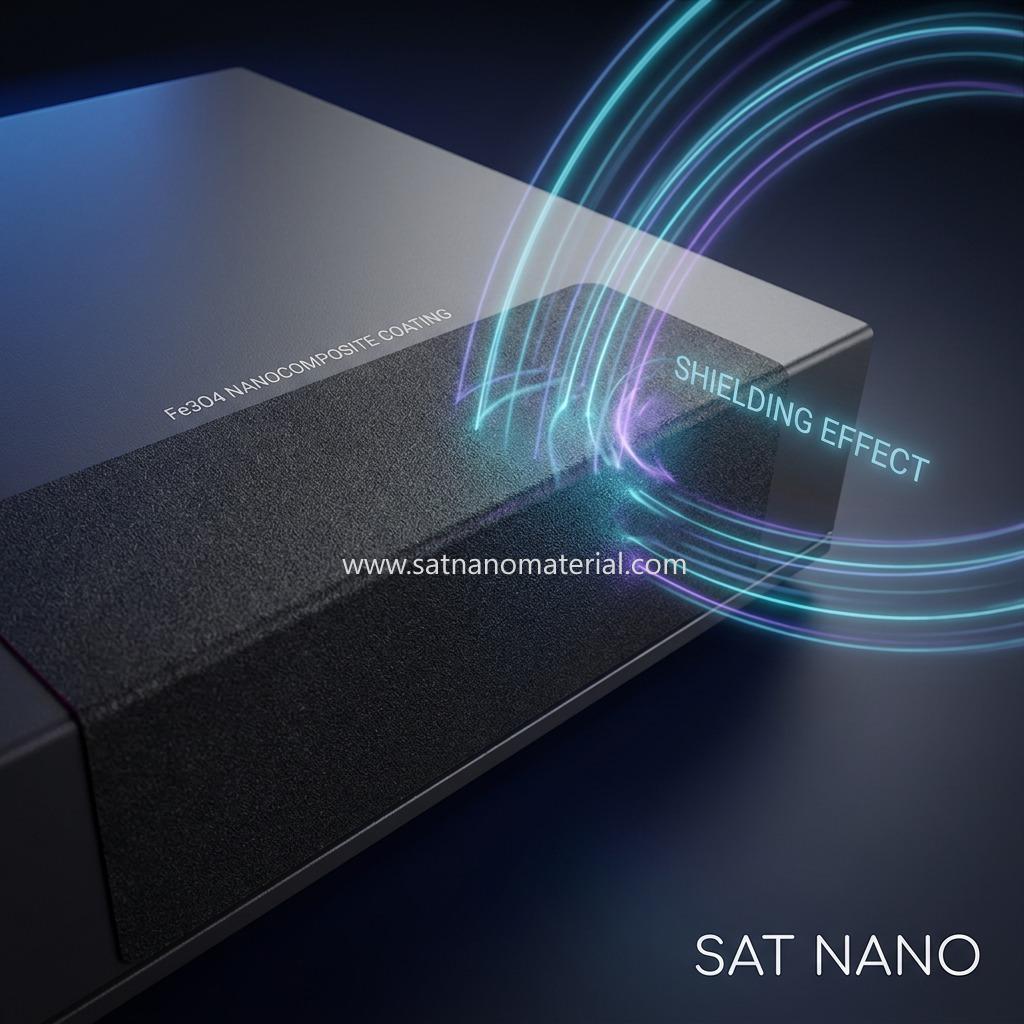
Esta guía proporciona un marco técnico integral para utilizar magnetita (Fe3O4) nanopartículas en polvo como carga funcional para formular recubrimientos protectores industriales con propiedades superiores antiestáticas y de blindaje electromagnético. Aborda específicamente desafíos de ingeniería críticos como la aglomeración de nanopartículas, la sedimentación, la optimización del umbral de percolación y la adhesión del recubrimiento.
1.1 Mecanismos conductivos y magnéticos duales
-
Descarga electrostática (ESD) / Antiestático:Fe3O4) es un semiconductor con una resistividad a temperatura ambiente de aproximadamente 10−210−2 a 10−3 Ω⋅cm10-3 Ω⋅cm. Una vez dispersas uniformemente en una matriz polimérica a una concentración suficiente, las nanopartículas entran en contacto entre sí (o utilizan el efecto túnel) para establecer una red conductora continua, permitiendo que las cargas estáticas se disipen de forma segura.
-
Blindaje contra interferencias electromagnéticas (EMI): A diferencia de los recubrimientos conductores puramente carbonosos o metálicos, Fe3O4 es ferrimagnético. Cuando las ondas electromagnéticas inciden sobre el recubrimiento, este atenúa el componente magnético mediante pérdidas por histéresis, resonancia de paredes de dominio y pérdidas por corrientes de Foucault, absorbiendo la radiación electromagnética.
1.2 Limitaciones de un solo relleno y redes sinérgicas
Debido a la resistividad intrínseca moderada de Fe3O4 en comparación con metales puros (Ag, Cu, Ni), depender únicamente de Fe3O4 para lograr una alta clasificación de blindaje (resistividad superficial ) requiere altos niveles de carga (típicamente 30%∼50%30%∼50% en peso). Esta alta carga incrementa drásticamente la viscosidad del recubrimiento, compromete las propiedades mecánicas (fragilidad) y debilita severamente la adhesión al sustrato.
-
Solución recomendada: Un "Red conductora sinérgica de relleno carbonoso / Fe₃O₄". La introducción de una fracción minoritaria (0.5%∼1.5%0.5%∼1.5% en peso) de nanotubos de carbono de paredes múltiples (MWCNTs) o negro de carbono conductor permite que actúen como "puentes conductores" que conectan las Fe3O4 nanopartículas. Esto reduce drásticamente el umbral de percolación, multiplica la conductividad eléctrica y reduce la Fe3O4 carga de Fe3O4 a un nivel manejable 15%∼25%15%∼25%.
Ingrediente
|
Especificación recomendada
|
Partes en peso (pbw)
|
Función / Mecanismo
|
Aglutinante formador de película
|
Resina epoxi E-51 (DGEBA)
|
100
|
Agente aglutinante primario; proporciona excelente resistencia a la corrosión y adhesión mecánica
|
Diluyente reactivo
|
Butyl Glycidyl Ether (BGE)
|
10 ~ 15
|
Reduce la viscosidad inicial de la resina para facilitar la incorporación de cargas
|
Carga funcional primaria
|
ModificadoFe3O4 Nanopolvo (20 ~ 50 nm)
|
25 ~ 35
|
Núcleo absorbente conductor y magnético
|
Co-relleno (opcional)
|
Nanotubos de carbono de pared múltiple (MWCNTs)
|
0.5 ~ 1.5
|
Conecta nanopartículas para establecer una red conductora robusta
|
Agente humectante y dispersante
|
Copolímero de bloque de alto peso molecular (p. ej., BYK-110)
|
1.0 ~ 2.0
|
Estabilización estérica; reduce la viscosidad y evita la aglomeración
|
Agente anti-sedimentación
|
Sílice pirogénica (p. ej., Aerosil 200 o modificada)
|
0.8 ~ 1.5
|
Forma una red tixotrópica para evitar la sedimentación de partículas pesadas de hierro
|
Agentes nivelantes y antiespumantes
|
Silicona modificada con poliéter
|
0.3 ~ 0.5
|
Elimina burbujas de aire y microporos, garantizando un acabado liso
|
Mezcla de disolventes
|
Xylene : Butanone : Butyl Acetate = 4:3:3
|
~30 ~ 50
|
Ajusta la viscosidad a parámetros de aplicación estándar (20-30 s, Copa Ford #4)
|
Agente de curado (Parte B)
|
Agente de curado de poliamida (p. ej., Poliamida 650)
|
50 ~ 60
|
Reticula con la Parte A a temperatura ambiente o elevada
|
3. Proceso de preparación paso a paso
Las nanopartículas poseen una energía superficial extremadamente alta y forman naturalmente aglomerados secundarios compactos. La mezcla estándar de bajo cizallamiento es insuficiente para romper estas estructuras. Debe seguirse el siguiente protocolo de cuatro etapas:
Etapa 1: Modificación química de superficie (silanización húmeda)
Esta etapa reemplaza los grupos hidroxilo superficiales hidrofílicos por cadenas organofílicas, evitando la re-aglomeración y mejorando la compatibilidad con resinas orgánicas.
-
Preparar solución de hidrólisis: Mezclar etanol anhidro y agua desionizada (relación en peso 95:5). Añadir Silane Coupling Agent KH-550 (equivalent to 1.5%∼2.0%1.5%∼2.0% del peso de Fe3O4). Ajustar el pH a 4.0 ~ 5.0 usando ácido acético glacial. Agitar a temperatura ambiente durante 30 minutos para asegurar la hidrólisis completa del silano.
-
Dispersión ultrasónica: Dispersar el Fe3O4
Fe3O4 nanopartículas en la solución de silano. Someter la suspensión a un tratamiento ultrasónico de alta intensidad durante 30 ~ 45 minutos para romper los aglomerados físicos sueltos.
-
Reacción de reflujo: Transferir la suspensión a un matraz de tres bocas equipado con un agitador mecánico y un condensador de reflujo. Calentar a 75 ~ 80 °C bajo agitación vigorosa durante 3 horas.
-
Lavado y recolección: Enfriar la mezcla. Colocar un imán potente de neodimio-hierro-boro (NdFeB) debajo del matraz para separar magnéticamente las nanopartículas de Fe3O4. Decantar el sobrenadante, reponer con etanol anhidro y repetir el ciclo de lavado 3 veces para eliminar cualquier silano no reaccionado.
Fe3O4Enfriar la mezcla. Colocar un imán potente de neodimio-hierro-boro (NdFeB) debajo del matraz para separar magnéticamente las nanopartículas de Fe3O4. Decantar el sobrenadante, reponer con etanol anhidro y repetir el ciclo de lavado 3 veces para eliminar cualquier silano no reaccionado.
-
Secado y pulverización: Secar la pasta húmeda en un horno de vacío a 70 °C durante 12 horas. Moler suavemente la torta seca de nuevo hasta obtener un polvo fino, organofílico de Fe3O4.
Fe3O4 polvo.
-
Cargar la resina epoxi, el diluyente reactivo, los solventes y el agente humectante/dispersante (BYK-110) en un recipiente de mezcla.
-
Ajustar el disolvente de alta velocidad a 500 rpm. Añadir gradualmente el nanopowder modificado Fe3O4 nanopartículas y los co-rellenos de carbono.
-
Aumentar la velocidad de cizallamiento a 1500 ~ 2000 rpm y dispersar durante 30 ~ 45 minutos para humedecer completamente los rellenos.
Etapa 3: Molienda con perlas de alta energía (Paso crítico)
-
Molienda con perlas: Bombear la suspensión premezclada a un molino de perlas horizontal cargado con perlas de zirconia estabilizada con itria de 0.2 ~ 0.4 mm (70~80% de tasa de llenado).
-
Control de temperatura: Hacer circular la suspensión a través de 3 ~ 4 pasadas. Mantener activa la camisa de refrigeración del molino, manteniendo la temperatura del producto por debajo de 50 °C para evitar la polimerización prematura de la resina.
-
Verificación de finura: Comprobar la finura utilizando un medidor Hegman. Detener la molienda una vez que la lectura sea ≤10 μm≤10 μm y la pasta tenga una textura brillante y cremosa.
Etapa 4: Posadición y estabilización
-
Mezclar el agente nivelante, el antiespumante y la pasta de sílice pirogénica pre-dispersada a 800 rpm.
-
Filtrar la base de recubrimiento a través de una malla de 200 (75 μmμμm) para eliminar cualquier partícula suelta. Envasar y sellar como Parte A (Base).
4. Guía de aplicación del recubrimiento
4.1 Tratamiento del sustrato
La adhesión determina la longevidad y la fiabilidad de la capa de blindaje.
-
Sustratos metálicos (carcasas de acero, aluminio): Desengrasar con solvente, luego granallar (Sa 2.5) o abrasionar para perfilar la superficie.
-
Sustratos plásticos (ABS, PC): Limpiar con alcohol isopropílico para eliminar agentes desmoldantes. Considerar tratamiento de plasma o una imprimación ligera para plásticos para promover la unión química.
-
Mezclar Parte A (Base) y Parte B (Agente de curado 650) en una proporción de 100 : 50 en peso (o según lo especificado por el valor de amina del agente de curado).
-
Ajustar la viscosidad añadiendo la mezcla de solventes bajo agitación mecánica.
-
Tiempo de inducción (maduración): Dejar reposar la mezcla durante 15 ~ 20 minutos antes de pulverizar. Esto inicia la prepolimerización y ayuda a expulsar microburbujas.
-
Vida útil de la mezcla: Utilizar la pintura catalizada dentro de 4 horas; desechar si comienza la gelificación.
4.3 Proceso de pulverización
-
Pulverización neumática con aire se recomienda encarecidamente para lograr una red uniforme e isotrópica. Use un tamaño de boquilla de 1.2 ~ 1.5 mm y una presión de aire de 0.3 ~ 0.5 MPa.
-
Aplicar en múltiples pasadas húmedo sobre húmedo (15∼20 μm15∼20 μm por pasada) con un tiempo de evaporación de 10 minutos entre pasadas. Apuntar a un espesor total de película seca (DFT) de 35 ~ 50 μmμm.
4.4 Condiciones de curado
-
Curado ambiental: Seco al tacto en 2 horas, seco duro en 24 horas (curado químico completo en 7 días a 25 °C).
-
Curado forzado (recomendado): Permitir 30 minutos de evaporación, luego hornear en un horno a 80 °C durante 2 horas. El curado térmico induce la contracción de la matriz, comprimiendo los rellenos conductores más cerca entre sí para lograr un rendimiento de conductividad/blindaje superior.
-
Resistividad superficial:
Medir mediante una sonda de 4 puntos o un medidor de alta resistencia.
-
Umbral antiestático: La resistividad superficial debe estar entre 105∼109 Ω/sq105∼109 Ω/sq.
-
Grado de blindaje electrostático/EMI: Resistividad superficial 104 Ω/sq (alcanzable con la Fe3O4Fe3O4/formulación de co-relleno MWCNT).
-
Adhesión por corte en rejilla:
Según GB/T 9286 o ASTM D3359, el recubrimiento debe alcanzar una calificación de Clase 0 o 1 (sin desprendimiento).
-
Eficacia de apantallamiento EMI (SE):
Evaluar en la banda de 30 MHz ~ 1.5 GHz usando un dispositivo de prueba con brida coaxial (ASTM D4935) para medir la atenuación en decibelios (dB).
6. Errores de ingeniería y mejores prácticas
-
La catástrofe de la sedimentación:
La densidad de Fe3O4 (5.18 g/cm35.18 g/cm3) es mucho mayor que la de la resina epoxi (aprox. 1.2 g/cm31.2 g/cm3). Las nanopartículas no estabilizadas se sedimentan formando un sedimento extremadamente duro que no puede redispersearse.
-
Mitigación: nunca omitir la "sílice pirógena o cera de poliamida (agente tixotrópico)". Esto crea una fuerte tensión de fluencia en condiciones estáticas que inmoviliza las nanopartículas en su lugar, mientras se fluidifica inmediatamente bajo esfuerzo de cizalladura.
-
Riesgo de oxidación térmica:
Las nanopartículas tienen una actividad química extremadamente alta. Si la temperatura aumenta durante la molienda o el secado, la magnetita puede oxidarse a hematita (α-Fe2O3α-Fe2O3), que no es magnética y es poco conductora (destruyendo las propiedades de apantallamiento). Mantener siempre la camisa de refrigeración por agua durante la molienda.
-
Precisión estequiométrica:
Pesar siempre el agente de curado con precisión. Los epoxis no se secan por evaporación; curan mediante estequiometría. Una proporción incorrecta conduce a una película pegajosa o a recubrimientos frágiles y altamente tensionados que se agrietan y rompen las rutas de apantallamiento.



 Servicio en línea
 13929258449
 admin@satnano.com
 + 8613929258449


