Alcance: determinación del contenido/pureza de Fe y elementos de impureza (Na, K, Ca, Mg, Al, Si, Mn, Cu, Pb, Cd, Cr, Ni, Zn, As, etc.)
Instrumentación: ICP-OES (Fe principal + impurezas comunes, nivel ppm) / ICP-MS (impurezas traza, nivel ppb)
1. Descripción general del método
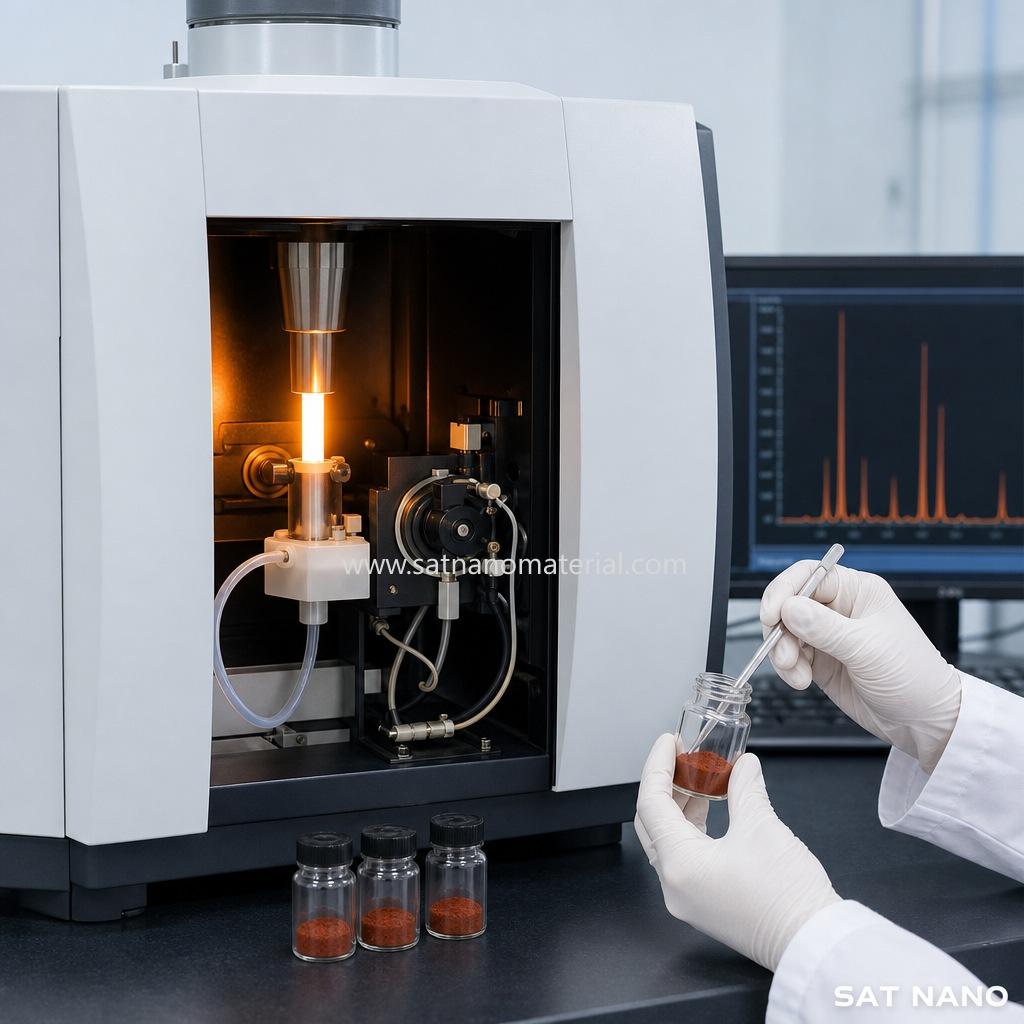
- ICP-OES (Espectrometría de Emisión Óptica con Plasma Acoplado Inductivamente): contenido principal de Fe + impurezas comunes (0,001%–100%), rápido y rentable
- ICP-MS (Espectrometría de Masas con Plasma Acoplado Inductivamente): impurezas traza a nivel ppb, máxima sensibilidad
- ICP mide únicamente el contenido total de elementos: no puede distinguir fases α/γ (usar XRD), no puede distinguir Fe²⁺/Fe³⁺ (usar titulación/XPS) y no puede medir oxígeno (usar fusión con gas inerte o analizador elemental)
2. Preparación de muestras (el paso crítico: digestión)
α-Fe₂O₃es un producto de calcinación a alta temperatura: red cristalina densa y químicamente inerte. La digestión determina el éxito o fracaso. Cuanto mayor sea la temperatura de calcinación, más difícil será disolverlo.
Opción A: digestión por microondas (recomendada — sellada, alta temperatura/presión, la más completa)
- Muestra: 0,1–0,2 g (secar primero a 105°C hasta peso constante; informar en base seca)
- Reactivos: 6 mL de HCl concentrado + 2 mL de HNO₃ concentrado (sistema de agua regia); añadir 0,5–1 mL de HF si se va a medir Si o hay impurezas que contienen sílice (deben usarse recipientes de PFA/teflón — nunca vidrio)
- Programa de ejemplo: aumentar hasta 180–200°C, mantener 20–30 min, enfriar antes de abrir
- Si queda residuo: repetir con agua regia fresca o añadir HF
Opción B: digestión por calentamiento a presión ambiente (alternativa sin microondas)
- 20–30 mL de HCl concentrado (o agua regia), calentar cerca de la ebullición bajo reflujo durante 1–2 h; prolongar según sea necesario
- Las muestras altamente calcinadas (>800°C) a menudo requieren adiciones repetidas de ácido o una pequeña cantidad de agente reductor auxiliar (p. ej., SnCl₂, ácido ascórbico — la reducción de Fe³⁺ a Fe²⁺ acelera la disolución)
Opción C: fusión alcalina (último recurso)
- Fusión con metaborato de litio (LiBO₂) o Na₂CO₃ a alta temperatura, seguida de lixiviación ácida
- Desventaja: introduce una gran carga de sales (TDS alto) → interferencias graves y alta dilución. Usar solo si nada más disuelve la muestra.
Nota de seguridad sobre HF: el HF ataca el vidrio y el nebulizador/antorcha de cuarzo. Las soluciones que contienen HF requieren un sistema de introducción de muestra resistente al HF o complejación con ácido bórico antes de la aspiración; trabajar siempre en una campana extractora con guantes de protección específicos.
3. Manipulación posterior a la digestión
- Transferir el digerido a un matraz aforado (PFA/plástico), completar con agua ultrapura (p. ej., 100 mL)
- Diluir al rango de medición: Fe principal 10–100 ppm; impurezas según sea necesario
- Igualar la acidez entre muestras y estándares (normalmente 1–5% de ácido) para evitar diferencias de nebulización
- Añadir estándares internos (ICP-OES: Sc, Y; ICP-MS: Sc, In, Rh) para corregir efectos de matriz y deriva
4. Condiciones del instrumento y líneas espectrales
- Líneas recomendadas (interferencias minimizadas):
- Fe: 259,94 nm, 238,20 nm (ICP-OES)
- Impurezas: Al 396,15 / Na 589,59 / K 766,49 / Ca 393,37 / Mg 279,55 / Mn 257,61 / Cu 324,75 / Pb 220,35 / Cd 228,80 / Cr 267,72 / Ni 231,60 / Zn 213,86 / Si 251,61 nm
- Verificar cada elemento con ≥2 líneas
- Efecto de matriz: la alta concentración de Fe suprime/mejora las señales de impurezas — igualar la matriz de la calibración con una base de Fe (la adición estándar es el método más preciso)
5. Calibración y control de calidad
- Estándar de Fe: hierro puro (≥99,99%) o solución estándar monoelemental de Fe; las impurezas proceden de un estándar mixto multielemental
- Ejecutar un blanco de reactivos durante todo el procedimiento (mismos ácidos, mismo proceso de digestión, misma cantidad de HF si se utiliza)
- Recuperación de adición: 90–110% es aceptable
- ≥2 réplicas; RSD
- Análisis de trazas: limpiar previamente los recipientes de digestión con remojo ácido + enjuague con agua ultrapura para evitar contaminación cruzada
6. Resultados e informes
- Contenido de Fe: convertir la concentración de Fe medida (corregida por blanco); para pureza, usar Pureza = 100% − Σ (contenidos de impurezas) (método de diferencia) — la lista de impurezas debe cubrir los requisitos del cliente/estándar (p. ej., especificación GB/T, ASTM o COA del cliente)
-
Informe sobre base seca: indique las condiciones de secado y la humedad/PPI
-
Contenidos de informe sugeridos: contenido de Fe, contenidos de impurezas individuales, método (incluida la digestión), líneas espectrales, límites de detección, recuperación de adición estándar, incertidumbre



 Servicio en línea
 13929258449
 admin@satnano.com
 + 8613929258449


